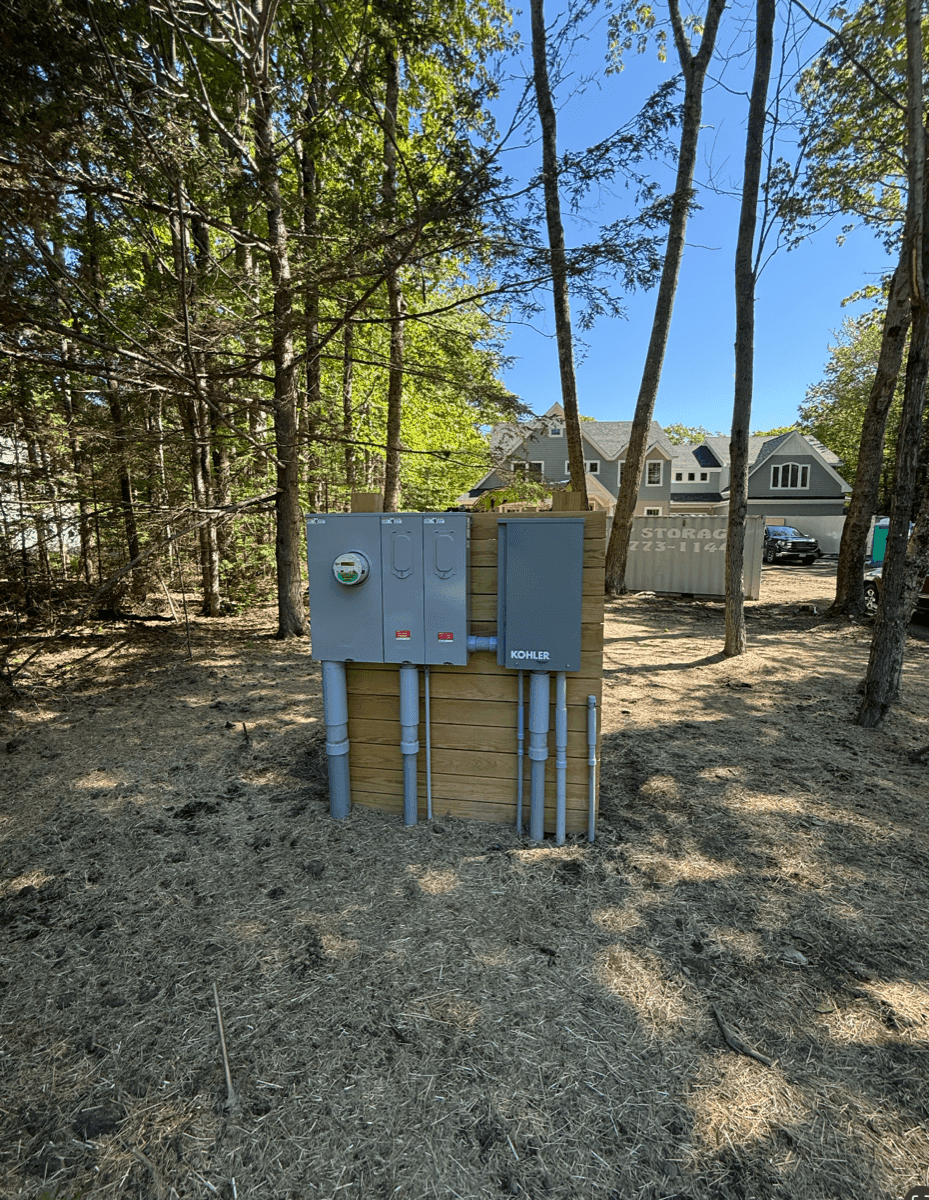
Roughly one Baldwin home in six is a mobile home, a larger share than in any neighboring town per the draft 2025 comprehensive plan, and a lot of service upgrades begin there. Older units tend to run on 100 amps or less, with panels whose replacement parts are scarce and, now and then, aluminum branch circuits. Their meter often stands on a pole or pedestal away from the home, so an upgrade covers three pieces together: the meter socket, the feeder running to the unit, and the panel inside it. Farmhouses make up the second group. Around 15 percent of the town's houses are older than 1940, and at that age a fuse box, a 60 amp service, or a Federal Pacific, Zinsco or Challenger panel, all brands known for trouble, is still a real possibility.
New loads push the other way. With oil heating about 64 percent of Baldwin homes, many owners are adding cold-climate heat pumps to trim fuel bills, and every outdoor unit wants a dedicated 240 volt circuit. Stack an electric water heater, the well pump that has always drawn from the panel, and possibly a car charger on top, and 100 amps is spent. The state's Electricians' Examining Board has advised utilities that replacing the full service on a one- or two-family home now calls for an outdoor emergency disconnect, mounted on the house or on a pedestal in sight of it and no more than 50 feet away, which shapes where the new equipment goes.
No electrical permit comes from the town office. On a single-family house the master electrician verifies the work; multi-meter services, apartment buildings and commercial jobs go to the Examining Board for a permit. Goodnow Electric files that paperwork when it applies, schedules the CMP disconnect and reconnect, and writes up a free estimate from a load calculation, with the owner present on the day. Long rural feeders collect lightning surges that can fry a well pump controller or a boiler's circuit board, so a whole-home surge protector belongs on the upgrade list.