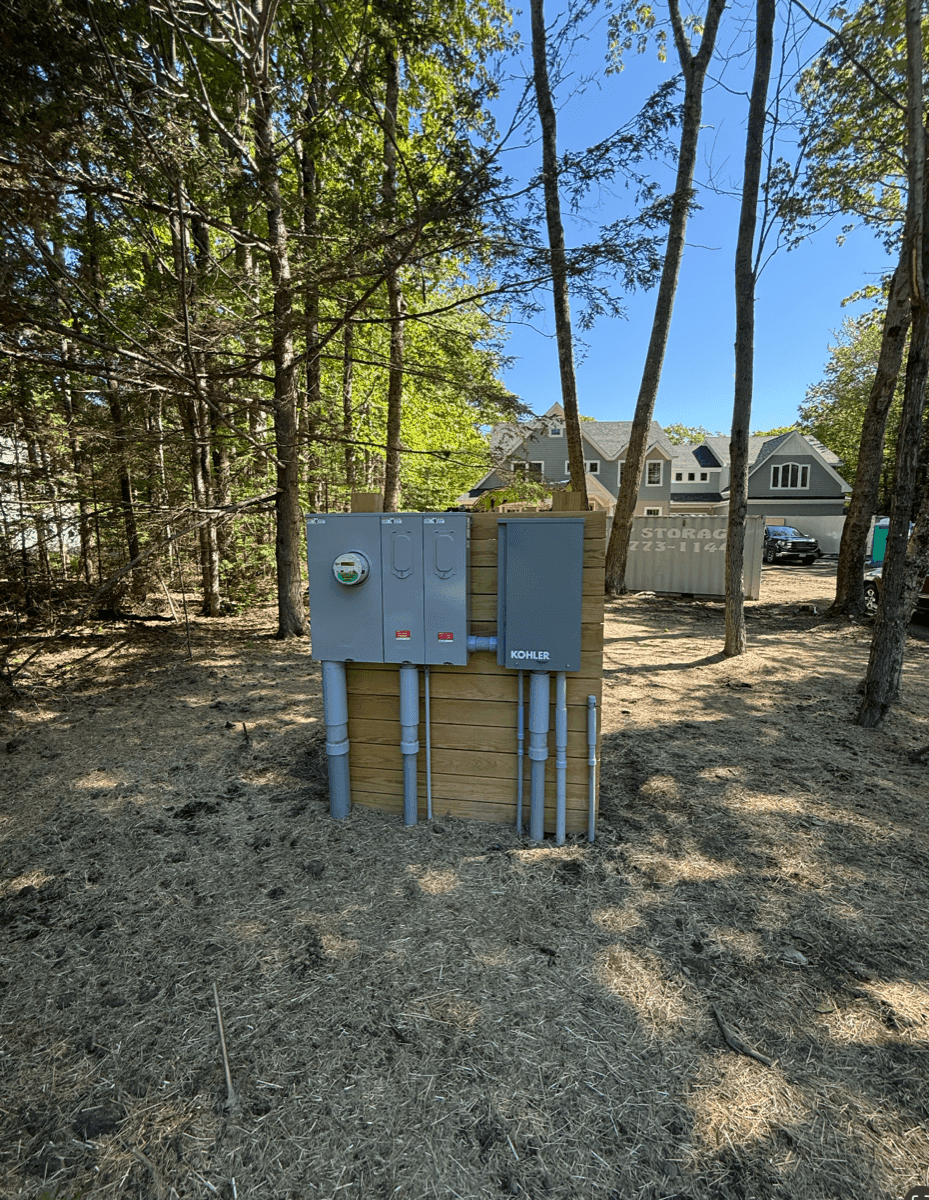
South Berwick’s largest group of houses is younger than most people guess. Nearly two in five of the town’s homes, about 38 percent, date from the 1980s and 1990s, and those capes, colonials and split-levels usually came with 100-amp or 150-amp services and breaker panels that are now thirty to forty-five years old. They are not dangerous by age alone, but they were sized for oil or propane heat, and with about 60 percent of homes still on oil and only about 4 percent heating with electricity, most of them have never carried a real heating load. A heat pump system, an induction range and an electric vehicle together can outrun them quickly.
The village is a different job. About 22 percent of South Berwick homes predate 1940, many of them around Central Square and along the streets near the old mills, and those houses can still have fuses, 60-amp services and masts on the front of historic facades. Roughly one home in nine is in a small multi-unit building, largely an older house split into apartments, where each unit needs its own meter and panel and the building needs a service large enough for all of them. Panels by Federal Pacific, Zinsco or Challenger, found in some homes of every era, are worth replacing whatever the load.
Paperwork varies with the building: a single-family house needs no electrical permit here, while an apartment house or a commercial building goes through the State Electrical Office. In every case the utility must cut the service and restore it afterward, and Goodnow Electric schedules that with CMP. When a one- or two-family house gets a new or completely replaced service, state guidance to utilities calls for an emergency disconnect mounted outside. A move from 100 to 200 amps, whole-home surge protection and a clearly labeled panel come with a free written estimate first. For an apartment building, the upgrade can be scheduled so that tenants know when the power will be off and for how long.