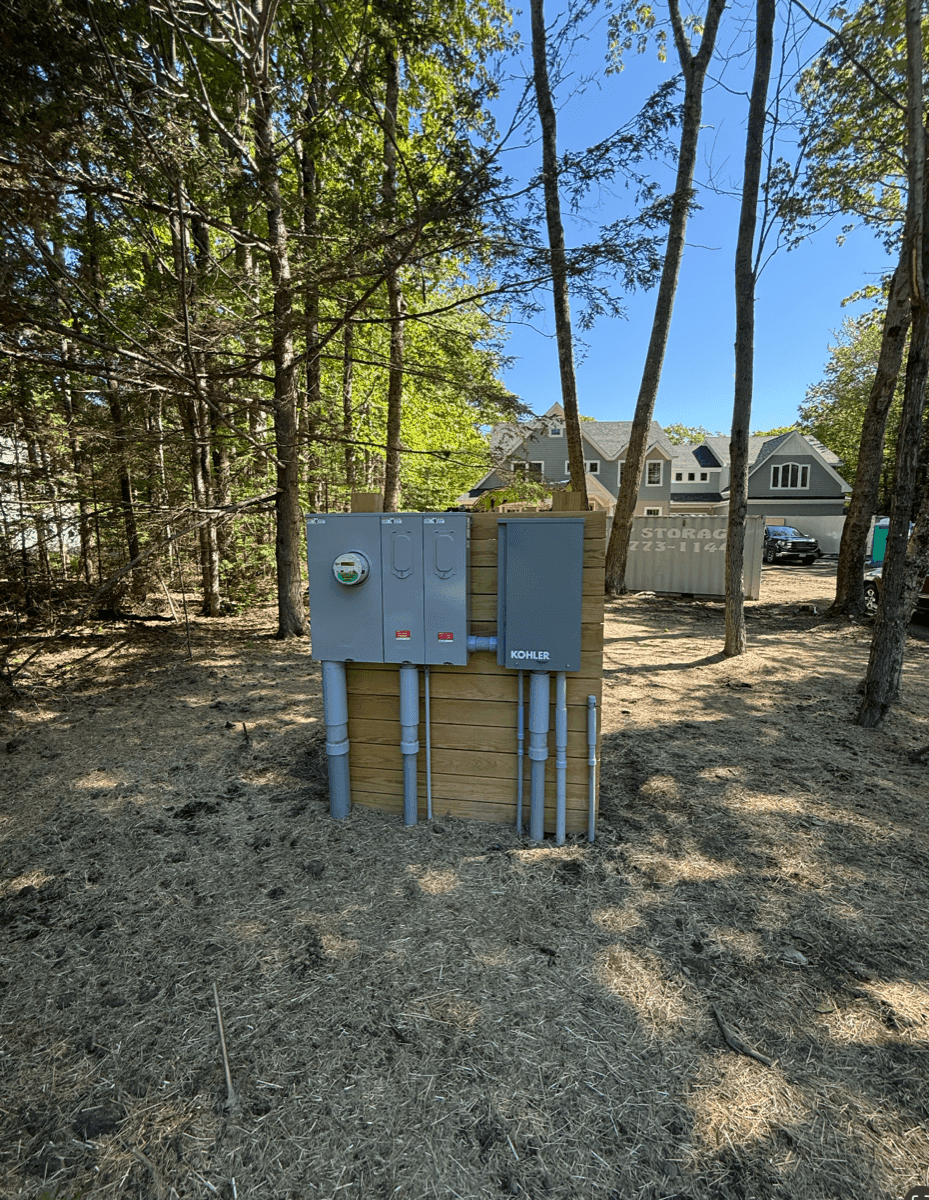
Few Casco panels are old fuse boxes; census figures put the median home here at 1988, so half the stock is newer than that. The trouble is usually size. Around 41 percent of Casco's housing sits empty outside the warm months, and a cottage on Pleasant Lake, Thomas Pond or Crescent Lake was often wired for little more than lights, a water heater and a pump, on a 60 or 100 amp service. Move in full-time, or try to heat that cottage through October with heat pumps, and the service runs out of room. Year-round houses hit the same limit from another side: roughly 60 percent still heat with oil, and every heat pump that takes over part of that job wants a dedicated 240 volt circuit.
One Casco home in five is a mobile home, and a lot of them take power from their own pole or pedestal instead of a panel fed from a main house. An upgrade there covers the whole chain: the meter socket, the feeder running out to the unit, and the panel inside it. Older units sometimes add aluminum branch circuits or a Federal Pacific, Zinsco or Challenger panel, any of which justifies replacement by itself. A newer rule reaches every full service change on a one- or two-family home, too. The state's Electricians' Examining Board has advised utilities that an emergency disconnect must now sit outdoors, in sight of the building and no more than 50 feet from it.
In this town the service paperwork goes to Central Maine Power rather than town hall. Casco's electrical service page lists CMP forms 1190 and 1360 for any new service or reconnection, and only a licensed electrician may complete the 1360. Goodnow Electric prepares that form, books the CMP disconnect and reconnect, and files a state permit on jobs that need one. Each estimate is free and written, built on a load calculation of the house, and the owner stays on site while the work is done. Planning a heat pump or charger? Say so at the estimate, so the new panel is sized for next winter's load and not just this summer's.